Niche Engineering: Chemokine Gradients Using PODS

Chemical gradients of signaling proteins such as chemokines and cytokines are fundamental drivers of cellular behavior in development, immunity, and tissue remodeling. From guiding immune cell migration to patterning tissues during morphogenesis, cells interpret spatial differences in bioactive molecules and respond through directed movements and changes in gene expression. However, creating stable and reproducible protein gradients in vitro has historically been challenging due to the short half-life and rapid diffusion of recombinant proteins in culture environments. Traditional approaches often rely on microfluidics or repeated additions of soluble proteins, but both can suffer from burst release, rapid dissipation, and difficult setup.
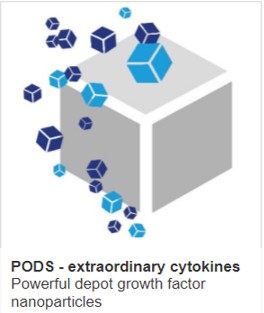
The POlyhedrin Delivery System (PODS®) addresses many of these limitations by enabling sustained, localized release of bioactive proteins, including chemokines, growth factors, and cytokines, from microscopic crystalline depots. Here, we explore how PODS can be used to generate chemokine gradients easily and reproducibly, and discuss key applications of this approach in cell biology and tissue engineering.
What Are PODS® and How Do They Work?
At the heart of PODS technology are protein co-crystals composed of a stable polyhedrin lattice and a bioactive cargo protein encapsulated within it. These crystals are typically on the micron or sub-micron scale and form via co-expression of polyhedrin with the protein of interest. The crystalline matrix protects the cargo from rapid degradation and provides a sustained release mechanism as endogenous proteases gradually degrade the lattice, releasing native, functional protein over days to weeks. Importantly, PODS crystals are intrinsically stable in aqueous environments and can be attached to surfaces or embedded within biomaterials, enabling spatially controlled delivery.
This sustained release setup fundamentally changes how protein gradients are generated. Instead of a soluble bolus that rapidly equilibrates throughout the medium, PODS crystals create local micro-depots of secretion. By placing these depots at defined positions, a concentration field emerges via diffusion and proteolytic release, decaying with distance from the source — a classic chemokine gradient.
Simple Setup for Chemokine Gradients
One of the simplest ways to create a stable gradient using PODS involves:
- Depositing a cluster of PODS crystals loaded with a chemokine (e.g., PODS® CXCL12 or an analogous chemokine) onto a defined region of a culture surface or within a gel scaffold.
- Allowing protease-mediated release of the chemokine into the surrounding medium.
- Cells respond to the gradient over time without the need for pumps, repetitive dosing, or specialized microfluidic chambers.
Experimental data from application notes show that clusters of PODS® particles sustainably secrete their cargo and establish concentration gradients. For example, PC12 neuronal precursor cells exposed to a field of PODS® human nerve growth factor (hNGF) migrated directionally toward the source and extended neurites, forming characteristic migration patterns around the PODS cluster without external devices.
Technical advantages of this approach include:
- Ease of gradient generation: simply place PODS in a defined region; no fluidic setup is required.
- Temporal stability: gradients persist as long as PODS continues to release chemokine, often for days or weeks.
- Spatial precision: PODS can be patterned on surfaces or incorporated into hydrogels and biomaterials to tailor gradient geometry.
- Reduced handling variability: sustained release minimizes the need for frequent media changes and repeated protein additions.
Applications of PODS-Based Chemokine Gradients
The ability to generate robust gradients with minimal setup opens the door to a wide range of experimental and translational applications:
- Cell Migration and Chemotaxis Studies
Chemotaxis — directed cell movement along a chemical gradient — is a core process in immunology, development, and cancer biology. PODS-derived gradients enable researchers to observe and quantify directed migration without the instability of soluble factors. For example, immune cells exposed to a PODS gradient of chemo-attractants can be tracked over extended periods, yielding more reproducible data than transient soluble setups.
- Neurobiology and Axonal Guidance
Gradients of neurotrophic factors such as nerve growth factor (NGF) or brain-derived neurotrophic factor (BDNF) are essential cues in neuronal pathfinding and differentiation. PODS gradients have been used to direct neurite outgrowth in vitro, offering a simple, physiologically relevant model for studies of neural development and injury repair.
- Developmental Biology and Tissue Patterning
Many developmental processes depend on morphogen gradients that instruct cell fate decisions. With PODS, complex gradient geometries can be established in 2D and 3D culture systems, facilitating studies of pattern formation, stem cell differentiation, and morphogenesis without sophisticated microfluidic devices.
- Biomaterials and Organoid Cultures
In organoid systems and 3D biomaterials, spatially controlled delivery of chemokines and growth factors is critical for replicating in vivo microenvironments. Embedding PODS crystals within scaffolds or hydrogels allows sustained release gradients throughout the construct, improving physiological relevance and experimental consistency.
For more details on the above and references, see here
Looking Forward
The use of PODS® for gradient formation represents an elegant merging of protein delivery engineering and biological experimentation. By stabilizing proteins and transforming them into localized, sustained sources, PODS simplifies gradient generation and offers new capabilities for probing cell behaviour in space and time. As this technology matures, its integration with advanced biomaterials, 3D culture platforms, and therapeutic delivery strategies promises to deepen our understanding of chemokine-mediated processes and accelerate discoveries in cell biology and regenerative medicine.
IMAGE A field of PODS (viewed under an SEM) attracts PC12 cells to its periphery CREDIT Cell GUidance Systems
Learn more about powerful technologies that are enabling research: