Why is the brain soft?

Among all adult human tissues, the brain occupies the extreme low end of the mechanical stiffness spectrum. While the body contains structures engineered for load bearing, tension, and compression, the brain is optimized for signaling, plasticity, and metabolic exchange. Its mechanical softness is not incidental. It is fundamental to its biological function.
How Soft Is the Brain?
Mechanical stiffness is typically quantified using elastic modulus, expressed in kilopascals. Brain tissue has a shear modulus on the order of approximately 0.5 to 1 kilopascal under physiological conditions. This places it among the softest tissues in the adult human body.
For comparison:
-
Adipose tissue ranges roughly from 2 to 10 kilopascals
-
Liver tissue in healthy states ranges from about 5 to 8 kilopascals
-
Skeletal muscle ranges from about 10 to 100 kilopascals depending on activation
-
Skin often falls between 20 and 150 kilopascals
-
Cartilage occupies the hundreds of kilopascals
-
Cortical bone and enamel are in the gigapascal range, millions of kilopascals
Even within the brain, mechanical heterogeneity exists. White matter is typically stiffer than gray matter due to its higher axonal density and structural organization. However, both remain orders of magnitude softer than structural tissues such as tendon, cartilage, or bone.
This extreme compliance means that the brain behaves more like a hydrated gel than a fibrous connective tissue.
Structural Basis of Brain Softness
The brain’s mechanical properties arise from several interconnected structural features.
High Water Content
Brain tissue is composed of more than 75 to 80 percent water by mass. This high fluid fraction dramatically reduces bulk stiffness. From a materials perspective, the brain resembles a hydrogel, where a soft polymeric network is saturated with interstitial fluid. Fluid mobility contributes to time dependent mechanical responses and lowers effective stiffness under slow loading conditions.
Sparse Extracellular Matrix
Unlike connective tissues that rely on dense collagen and elastin networks for mechanical reinforcement, the brain extracellular matrix is comparatively sparse and compositionally distinct. It is enriched in proteoglycans and glycosaminoglycans rather than fibrillar collagen. These components support biochemical signaling and cell migration but provide limited tensile strength.
The absence of dense load bearing fibers is a major determinant of the brain’s low elastic modulus.
Cellular Architecture
Neurons and glial cells dominate brain structure. Their cytoskeletal frameworks are designed for intracellular transport and electrical function rather than macroscopic force resistance. Axons do possess structural organization through microtubules and neurofilaments, yet their contribution to bulk stiffness remains modest relative to collagen rich tissues elsewhere in the body.
The resulting tissue architecture is compliant, highly hydrated, and minimally reinforced.
Viscoelastic and Poroelastic Behavior
The brain exhibits both viscoelastic and poroelastic mechanical behavior. Under rapid loading, such as impact, it displays rate dependent stiffening. Under slower deformation, interstitial fluid redistributes and the tissue flows more readily. This complex mechanical profile reflects the coupling between solid cellular components and fluid movement within a porous matrix.
Why the Brain Needs to Be Soft
The mechanical softness of the brain supports several essential biological functions.
Support of Neural Plasticity
Neurons extend axons and dendrites through their surrounding environment. A compliant matrix reduces mechanical resistance to neurite outgrowth and synaptic remodeling. Substrate stiffness is known to influence cell morphology, differentiation, and signaling pathways. In a soft mechanical environment, neural cells maintain physiologically relevant architecture and connectivity.
Minimization of Mechanical Stress
Electrical signaling depends on finely tuned cytoskeletal organization and membrane integrity. A stiffer environment would increase mechanical stress concentrations during normal physiological motion. A compliant tissue reduces strain gradients and protects delicate intracellular structures.
Reliance on External Protection
Instead of relying on intrinsic stiffness for protection, the brain is safeguarded structurally. The skull provides rigid mechanical shielding. Cerebrospinal fluid distributes forces and reduces peak stress. Meningeal layers compartmentalize and stabilize the tissue. This division of labor allows the brain to remain mechanically soft while still protected at the organ level.
The Importance of Softness In Vitro
The recognition of the brain’s ultrasoft nature has reshaped experimental neuroscience and biomaterials engineering.
Traditional cell culture systems often rely on polystyrene or glass substrates with stiffness values in the gigapascal range. These surfaces are many orders of magnitude stiffer than brain tissue. Neural cells cultured on such rigid materials exhibit altered morphology, cytoskeletal tension, gene expression, and differentiation profiles compared to in vivo conditions.
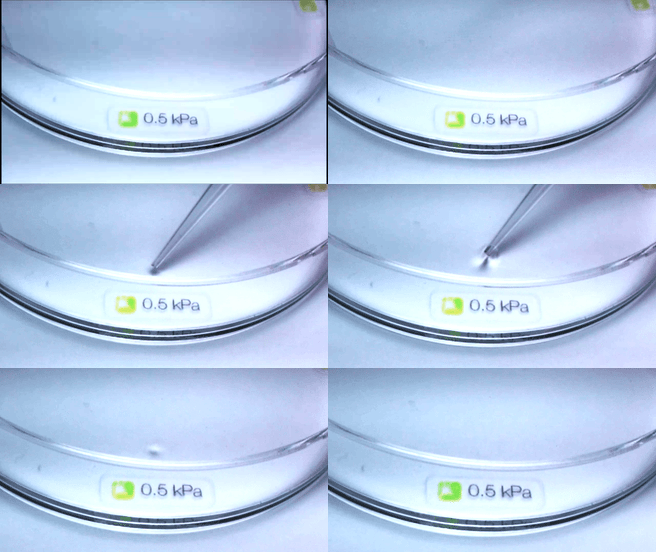
Softwell products reproduce physiologicaly relevant stiffness for cell culture
To address this mismatch, researchers increasingly use tunable hydrogels , notably Softwell, with stiffness values in the 0.1 to 5 kilopascal range to better approximate brain mechanics. Substrate stiffness in this physiological window has been shown to influence:
-
Neural stem cell lineage specification
-
Astrocyte activation states
-
Microglial behavior
-
Axonal extension and branching patterns
Mechanically accurate in vitro models are also essential for studying traumatic injury, tumor invasion, and neurodegenerative disease. Mechanical cues modulate cell signaling pathways linked to inflammation, fibrosis, and degeneration. Without replicating brain like softness, these mechanobiological responses can be distorted.
Thus, the mechanical fidelity of experimental systems is not a peripheral concern. It is central to translational relevance.
Conclusion
The brain is one of the softest tissues in the adult human body, with stiffness values near 1 kilopascal. Its extreme compliance arises from high water content, sparse structural matrix, compliant cellular architecture, and fluid coupled mechanical behavior. This softness enables neural plasticity and minimizes internal stress while external anatomical structures provide protection.
Understanding the mechanical identity of the brain is essential for injury biomechanics, disease modeling, neural engineering, and the development of physiologically accurate in vitro systems. The brain is not merely biochemically specialized. It is mechanically unique.
IMAGE Brain softness CREDIT CellGS
Learn more about powerful technologies that are enabling research: