Immune Gateways Bypass the Blood Brain Barrier

Immune Gateways Bypass the Blood–Brain Barrier for Drug Delivery
Stroke is a leading cause of death and long-term disability worldwide, yet therapeutic options remain stubbornly limited. The core problem has always been the same: the brain is extraordinarily difficult to reach. The blood–brain barrier (BBB), a tightly regulated endothelial interface separating the systemic circulation from the central nervous system (CNS), excludes approximately 98% of small-molecule drugs and virtually all large-molecule therapeutics from entering the brain parenchyma. For decades, researchers have been searching for a reliable, clinically translatable way around this formidable obstacle. A landmark study published in Cell in January 2026 may have found one.
The Skull as a Drug Delivery Gateway
Gao et al. from Tsinghua University and Beijing Tiantan Hospital reported a strategy in which drug-loaded nanoparticles "hijack" immune cells residing in the calvarial (skull) bone marrow to deliver therapeutic cargo directly into the brain, bypassing the BBB entirely. The study has attracted widespread commentary in the scientific community and was featured as a research highlight in Nature Reviews Neurology.
The key insight is anatomical. Recent discoveries in neuroimmunology had revealed that immune cells in the calvarial bone marrow naturally migrate into the CNS through microscopic channels connecting the skull to the meninges, a route entirely distinct from the classical vascular BBB pathway. This skull–meninges microchannel system provides a pre-existing physiological conduit to the brain that, until recently, had gone largely unexploited for therapeutic purposes.
Gao et al. demonstrated that by injecting albumin-based nanoparticles directly into the skull bone marrow, local myeloid immune cells could be loaded with therapeutic cargo in situ. These "hijacked" immune cells then exploited their natural migration pathway through the skull–meninges channels, homing rapidly to sites of brain injury in response to CNS perturbation, delivering their therapeutic payload to the lesion with striking precision.
In preclinical stroke models, the approach achieved meaningful improvements in both short- and long-term neurological outcomes. Critically, a prospective clinical component of the study further supported the translational feasibility of the calvarial immune access route in patients with malignant stroke. As lead author Dr. Xize Gao summarised: "The calvarial bone marrow is not just a passive reservoir of immune cells, but a functional gateway to the brain."
This establishes immune-assisted transport through the skull as a genuinely clinically viable platform. The question now is: what cargo should those immune cells carry?
Why PODS® Are an Ideal Payload for Immune-Assisted CNS Delivery
The calvarial immune gateway approach requires a therapeutic cargo that can survive uptake and intracellular processing by phagocytic immune cells, remain bioactive during transport, and exert a sustained neuroprotective effect upon release at the lesion site. These are demanding requirements, and they map precisely onto the properties of PODS® (POlyhedrin Delivery System) technology, developed by Cambridge-based biotech Cell Guidance Systems.
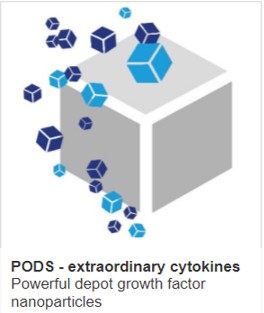
PODS® are sub-micron to micron-scale protein microcrystals built from the self-assembling polyhedrin protein. A therapeutic cargo (such as a neurotrophic growth factor) is encased within the crystalline lattice during its formation inside insect expression cells, producing a stable, cubic microparticle that slowly releases bioactive protein over weeks to months in response to protease activity. This sustained, near-zero-order release kinetics addresses one of the most persistent challenges in neurotherapeutics: the notoriously short half-life of unprotected growth factors in biological environments.
Critically for this application, PODS® are the ideal size and rigidity for phagocytic uptake. Professional phagocytes (including monocytes, macrophages, and microglia) efficiently internalise PODS® particles through active phagocytosis, and research has demonstrated that PODS® ingestion does not impair macrophage mobility, chemotaxis, or migration. Cargo proteins survive the harsh phagolysosomal environment, retaining bioactivity upon release.
A 2024 study published in Materials by Parwana et al. (Keele University) demonstrated that primary mouse cortical microglia (the brain's resident immune cells) internalise reporter-protein-functionalised PODS® particles within 24 hours, with no acute toxicity, no morphological change, and no signs of microglial activation. PODS® were found in both cytosolic and perinuclear locations within microglia, pointing to intracellular processing pathways that could support cargo secretion and local delivery to surrounding tissue.
PODS® Growth Factors for Neuroprotection in Stroke
The therapeutic rationale for delivering growth factors to the post-stroke brain is well established. Factors such as BDNF (Brain-Derived Neurotrophic Factor) and GDNF (Glial Cell Line-Derived Neurotrophic Factor) promote neuronal survival, reduce apoptosis, and support tissue remodelling, but their clinical translation has been frustrated by rapid degradation in vivo and the difficulty of sustained local delivery.
Cell Guidance Systems has demonstrated that PODS®-encapsulated BDNF can sustain neurotrophin release over prolonged periods in demanding biological environments, supporting neuronal differentiation and survival in cochlear implant and retinal organoid research applications.
The calvarial immune gateway described by Gao et al. could transform how such growth factors are administered in acute stroke. Rather than attempting direct intraparenchymal injection or relying on systemic delivery blocked by the intact BBB, PODS® crystals loaded with BDNF, GDNF, or other neuroprotective proteins could be introduced into the calvarial bone marrow, phagocytosed by local myeloid cells, and trafficked through the skull–meninges microchannels to the ischaemic penumbra, where protease-driven sustained release could maintain therapeutic concentrations at the lesion site over the critical days and weeks of post-stroke recovery.
A Convergence of Biology and Bioengineering
What makes this convergence compelling is that it is not hypothetical. The biological pathway has been validated in a prospective clinical setting. The cargo system, PODS®, has been shown to survive phagocytic uptake in peripheral macrophages and, critically, in CNS microglia. The therapeutic targets (neurotrophic growth factors for stroke) are biologically well-characterised. All three elements are available now.
The next step is to combine them: to demonstrate that PODS® carrying neuroprotective cargo can be loaded into calvarial myeloid cells in situ, migrate through the skull–meninges route, and achieve sustained therapeutic protein delivery to stroke lesions. Cell Guidance Systems offers a growing portfolio of PODS® growth factors, including BDNF, GDNF, EGF, FGF, and others, suitable for exactly this kind of exploratory research.
For researchers investigating CNS drug delivery, stroke neuroprotection, or immune-mediated transport platforms, this is a moment of genuine opportunity. The gateway is open.
Explore PODS® technology and growth factor products at cellgs.com.
IMAGE Loading of cranial bone marrow immune cells with particles for BBB drug delivery CREDIT Cell Guidance Systems
Learn more about powerful technologies that are enabling research: