Life support: Choosing a cell culture hydrogel

Hydrogels have moved from being a niche option for specialist 3D culture into the mainstream of cell-based research. Organoid systems, stem cell differentiation protocols, primary cell expansion, drug screening platforms and regenerative medicine pipelines all increasingly depend on a hydrogel matrix that does more than physically support the cells. The matrix is now expected to instruct cellular behaviour: directing differentiation, modulating proliferation, supporting polarity and providing the mechanical cues that two-dimensional plastic cannot. The choice of hydrogel determines, to a large extent, whether the cultured cells behave like their in vivo counterparts or drift towards the artefactual phenotypes typical of monolayer culture on tissue-culture plastic.
This article examines the parameters that govern hydrogel selection for cell culture: stiffness and elasticity, surface charge, presentation of functional motifs, biodegradability, defined versus undefined composition, handling characteristics and analytical accessibility. It then compares the principal hydrogel classes in current use (plant-derived, animal-derived, synthetic, composite and self-assembling peptide hydrogels) against these criteria, and provides a decision framework for matching a hydrogel to a specific application. The intended audience is researchers selecting a matrix for a new culture system or troubleshooting unsatisfactory results from an existing one.
| Key Point |
| There is no universal cell culture hydrogel. The optimal matrix is determined by the cell type, the biological question and the downstream analytical requirements. Stiffness, functional motif presentation, defined composition and ease of handling each contribute independently to culture outcomes. Animal-derived hydrogels deliver biological complexity but at the cost of batch variability and translational risk; defined synthetic and peptide hydrogels offer reproducibility and clinical compatibility but require careful tuning to match the cellular context. |
What a Hydrogel Is and What It Has to Do
A hydrogel is a network of crosslinked polymers swollen with water, typically containing more than 90% water by volume. In cell culture, the hydrogel is asked to replicate, at least partially, the function of the native extracellular matrix (ECM). The ECM is itself a complex hydrogel: a tissue-specific composite of collagens, proteoglycans, glycosaminoglycans, laminin, fibronectin and bound signalling molecules, organised into a three-dimensional architecture that varies dramatically between tissues. Tendon ECM is dominated by aligned type I collagen fibres carrying high tensile loads. Brain ECM is comparatively soft, rich in hyaluronic acid and lecticans, and largely free of fibrillar collagen. Cartilage ECM is heavily proteoglycan-loaded, providing the compressive resilience appropriate to its function.
The native ECM does three things simultaneously: it provides physical support and a permissive medium for nutrient and waste exchange, it presents biochemical motifs that anchor and instruct adherent cells, and it presents mechanical cues (stiffness, viscoelasticity, topography) that are now known to influence cell fate as strongly as soluble signalling factors. A cell culture hydrogel is judged on how well it can perform these three functions for a particular cell type.
The Parameters That Matter
Stiffness and Elasticity
Substrate stiffness, expressed as the elastic modulus in pascals (Pa) or kilopascals (kPa), is one of the most consequential variables in hydrogel selection. Cells sense stiffness through integrin-mediated mechanotransduction, and stiffness influences proliferation, migration, differentiation and the maintenance of tissue-specific phenotypes. The classic demonstration by Engler and colleagues showed that mesenchymal stem cells differentiate towards neuronal, myogenic or osteogenic fates depending solely on substrate stiffness within a range of approximately 1 to 40 kPa, in the absence of inductive soluble factors [1].
Native tissue stiffness varies over four orders of magnitude. Brain tissue measures approximately 0.1 to 1 kPa; soft tissues such as fat and lung sit in the 1 to 5 kPa range; muscle is around 8 to 17 kPa; precalcified bone reaches 25 to 40 kPa, and mineralised bone is in the megapascal range. A hydrogel intended to support a particular cell type should fall within the stiffness range of that cell's native environment, unless the experimental design specifically requires deviation from it.
Tunability of stiffness is therefore a critical specification. Hydrogels in which stiffness can be modulated by changing crosslink density, polymer concentration or peptide composition allow one platform to be matched to multiple cell types. Hydrogels with a fixed stiffness imposed by their chemistry are correspondingly limited in scope.
Functional Motifs
Cells anchor to the ECM through integrin engagement of specific peptide motifs presented by ECM proteins. The arginine-glycine-aspartate (RGD) tripeptide, found in fibronectin, vitronectin and several other ECM proteins, is the most widely engaged motif and is recognised by multiple integrin heterodimers. Laminin-derived motifs (IKVAV, YIGSR) support neural cell adhesion. Collagen-derived GFOGER engages collagen-binding integrins. Heparin-binding domains tether growth factors to the matrix in a presentation that mimics the in vivo context.
A hydrogel that lacks any cell-binding motifs supports no adherent cell culture: cells fail to anchor, undergo anoikis or aggregate into non-physiological clusters. A hydrogel containing a single motif at a defined density supports anchorage but may not support the full repertoire of integrin engagements that the cell would experience in vivo. The ability to present multiple motifs, at controlled densities and in defined spatial arrangements, is a significant advantage in modelling tissue-specific cell-matrix interactions.
Surface Charge
The net surface charge of a hydrogel, often overlooked in initial selection, can have substantial effects on cell behaviour and on the partitioning of soluble factors within the matrix. Most mammalian cell membranes carry a net negative surface charge under physiological conditions. Strongly cationic hydrogels can drive non-specific cell adhesion that bypasses physiological integrin signalling, and can sequester negatively charged growth factors and cytokines, distorting the soluble signalling environment. Strongly anionic hydrogels can repel cells and impede attachment.
The capacity to tune charge, by selecting peptide sequences with appropriate isoelectric points or by chemical modification of synthetic backbones, is an under-appreciated dimension of hydrogel design. Charge tuning is particularly relevant for cell types whose native ECM is itself strongly charged, such as cartilage chondrocytes (where proteoglycan-rich ECM is heavily anionic) or neural cells (where hyaluronic acid contributes a defined charge environment).
Biodegradability
Cells encapsulated in a hydrogel need to remodel their immediate environment to migrate, proliferate and deposit their own ECM. A hydrogel that is fully resistant to cellular remodelling acts as a static cage, supporting survival but not the dynamic morphogenetic processes that underlie tissue formation. A hydrogel that degrades too rapidly fails to provide sustained support, and the matrix is lost before the cells have had time to deposit a replacement ECM.
Matrix metalloproteinase (MMP)-cleavable peptide crosslinkers in synthetic hydrogels allow degradation rates to be matched to the remodelling capacity of the encapsulated cell type. Plant-derived hydrogels such as alginate are not enzymatically degraded by mammalian cells but can be dissolved by chelation of crosslinking calcium ions, providing a controlled release mechanism rather than cell-driven remodelling. Animal-derived hydrogels degrade through a combination of MMP and other protease activities, often at rates that are difficult to control or predict from batch to batch. Translational applications, where the hydrogel will eventually be resorbed in vivo, require predictable and tunable degradation profiles.
Defined Composition
Defined composition means that every component of the hydrogel is known by chemical identity and concentration. Animal-derived hydrogels such as Matrigel are, by contrast, complex mixtures of hundreds of identified and unidentified proteins, growth factors and other biomolecules at variable concentrations. The pragmatic consequence of undefined composition is batch-to-batch variability that introduces noise into experimental results and makes mechanistic interpretation difficult: if a culture outcome changes between batches, the source of that change is often unrecoverable.
Defined hydrogels eliminate this confounding variable. They also remove the regulatory and ethical obstacles to translational use: a hydrogel containing animal-derived components, whether for cell therapy delivery or for tissue engineering implants, faces a substantially harder regulatory path than a fully synthetic or peptide-based equivalent. For research applications where reproducibility is the priority, and for development pipelines aimed at clinical translation, defined composition is increasingly a baseline requirement rather than a preference.
Handling and Workflow Compatibility
A hydrogel that performs well in principle but is difficult to use in practice will see limited adoption. Practical handling considerations include the gelation trigger (temperature, pH, ion concentration, UV exposure, shear), the time available for cell mixing before gelation completes, viscosity during mixing, the geometry of culture vessels with which the gel is compatible, and storage and shelf-life requirements.
Temperature-triggered gelation, as used by collagen and Matrigel, requires all manipulations to be performed on ice and gelation initiated by warming. UV-triggered crosslinking imposes a requirement for UV-tolerant cell types and appropriate equipment. Ion-triggered gelation, as used by alginate and many peptide hydrogels, allows the gel to be prepared at room temperature and to set in response to the calcium and other ions present in standard cell culture media, simplifying the workflow considerably.
Analytical Accessibility
The hydrogel chosen for a culture system constrains the assays that can subsequently be performed. Immunofluorescence imaging within a hydrogel requires that the matrix be optically transparent and amenable to fixation, permeabilisation and antibody penetration. Cell recovery from the hydrogel for downstream flow cytometry, RNA extraction or proteomic analysis requires a gentle dissociation protocol that does not damage the cells or destroy their analytes. Live imaging requires optical clarity and matrix stability over the imaging timescale. Hydrogels with proprietary or aggressive dissociation chemistries can compromise downstream analysis; those amenable to enzymatic, chelation-based or mechanical recovery preserve the broadest range of analytical options.
The Principal Hydrogel Classes
Plant-Derived Hydrogels
Plant-derived hydrogels are extracted from non-animal biological sources. Alginate, derived from brown seaweed, gels in the presence of divalent cations (typically calcium) and dissolves on chelation, providing a controllable encapsulation and release system. Agarose, from red seaweed, gels thermally and provides mechanical support but lacks intrinsic cell-binding motifs. Cellulose-based hydrogels, including the Growdex family from wood pulp, offer fibrillar architecture and tunable concentration but are likewise lacking in functional motifs unless modified.
The principal advantage of plant-derived hydrogels is freedom from animal-source supply chains and the associated regulatory complexity. The principal limitation is the absence of native cell-binding chemistry: cells encapsulated in an unmodified plant-derived hydrogel typically fail to adhere unless RGD or similar motifs have been chemically grafted onto the polymer backbone. This grafting is technically feasible and commercially available, but it adds complexity and cost. Stiffness tunability in plant-derived hydrogels is generally good, achieved through polymer concentration and crosslinker density.
Animal-Derived Hydrogels
Animal-derived hydrogels include collagen (extracted from skin, tendon or other connective tissues), gelatin (denatured collagen, typically porcine), fibrin (from blood plasma), Jellagen (jellyfish-derived collagen) and Matrigel (extracted from murine Engelbreth-Holm-Swarm sarcoma). They deliver native ECM proteins in approximately native conformations, with intact functional motifs and, in the case of Matrigel, a complex mixture of growth factors, proteoglycans and other biomolecules.
The strength of this class is biological complexity. Matrigel in particular has been the de facto standard for organoid culture and for many stem cell differentiation protocols precisely because its complexity supports cell behaviours that simpler matrices cannot reproduce. The weaknesses are equally well documented: batch variability arising from biological source variation, occasional supply disruptions, presence of residual growth factors at variable concentrations, the inability to define the matrix composition for mechanistic studies, ethical considerations associated with animal sourcing, and the regulatory burden of using animal-derived materials in any application destined for clinical translation [2].
Synthetic Hydrogels
Synthetic hydrogels are built from chemically defined polymers. Polyacrylamide, used extensively for 2D mechanotransduction studies, provides excellent stiffness control but is not suitable for 3D encapsulation because of the cytotoxicity of unreacted acrylamide monomers. Polyethylene glycol (PEG), often functionalised with crosslinkable acrylate, methacrylate or norbornene groups, supports 3D encapsulation when combined with cell-binding peptides and protease-cleavable crosslinkers. Polyvinyl alcohol and various other synthetic backbones are used in specialised applications.
The principal advantage of synthetic hydrogels is complete compositional control: every component is defined, batch variability is minimal, and properties such as stiffness and degradation rate can be tuned independently. The principal limitation is that synthetic hydrogels are biologically inert by default. Without grafted motifs, encapsulated cells fail to adhere. The motif chemistry that must be added to make a synthetic hydrogel functional is itself a substantial engineering exercise, and the resulting matrix may still lack the spatial complexity of the native ECM.
Composite Hydrogels
Composite hydrogels combine two or more polymer systems to capture the strengths of each. Gelatin-polysaccharide composites provide animal-derived motifs alongside polysaccharide structural support. Peptide-agarose composites combine the cell-instructive properties of peptides with the mechanical robustness of agarose. The composite approach has produced some highly successful matrices for specific applications but introduces additional formulation complexity and can complicate the interpretation of results when multiple variables in the matrix change together.
Self-Assembling Peptide Hydrogels
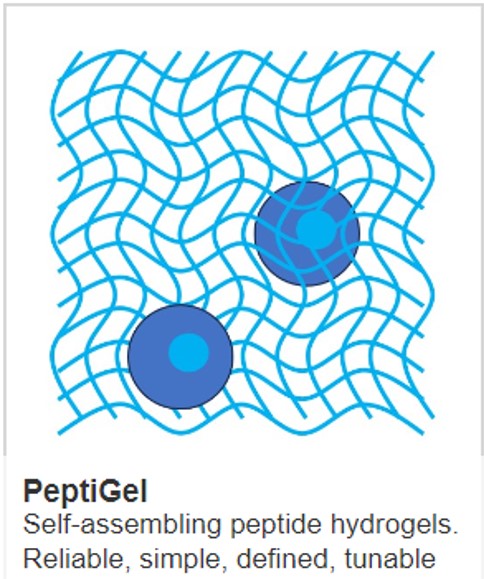
Self-assembling peptide hydrogels (SAPHs) are formed from short, rationally designed peptide sequences that assemble into nanofibrillar networks under physiological conditions. The peptide sequence determines the assembly behaviour, the mechanical properties of the resulting gel, the surface charge presented to cells, and the functional motifs available for cell engagement. Because the entire matrix is constructed from defined peptides, the composition is fully known and reproducible from batch to batch.
The PeptiGel family from Cell Guidance Systems is a self-assembling peptide hydrogel platform offering multiple variants with different stiffness ranges, surface charges and functional motif presentations. PeptiGel variants gel in response to the ionic environment of standard cell culture media, simplifying the encapsulation workflow. Stiffness is tunable across a range relevant to most soft tissues. Functional motifs including RGD, IKVAV and others can be incorporated by selecting the appropriate PeptiGel variant. The nanofibrillar architecture mimics the fibrillar organisation of native ECM more closely than amorphous gel networks.
SAPHs combine the defined composition of synthetic hydrogels with biological functionality of motif-rich animal-derived hydrogels, while avoiding the supply, regulatory and ethical complexities of animal sourcing. They are particularly well suited to applications where reproducibility matters and where the eventual goal is clinical translation, since the absence of animal-derived components simplifies the regulatory pathway substantially.
Comparing the Classes Against the Selection Criteria
| Hydrogel Class Comparison | |||||
| Criterion | Plant-derived | Animal-derived | Synthetic (PEG) | Composite | SAPH (PeptiGel) |
| Defined composition | Yes (mostly) | No | Yes | Variable | Yes |
| Stiffness tunability | Good | Limited | Excellent | Good | Excellent |
| Native cell-binding motifs | No (require grafting) | Yes (multiple) | No (require grafting) | Often yes | Yes (designed in) |
| Charge tunability | Limited | Limited | Good | Limited | Excellent |
| Batch reproducibility | Good | Poor | Excellent | Variable | Excellent |
| Animal-free | Yes | No | Yes | Variable | Yes |
| Translational pathway | Moderate | Difficult | Good | Variable | Good |
| Ease of handling | Good | Variable (cold-chain) | Variable (UV often required) | Variable | Good (ion-triggered) |
Matching the Hydrogel to the Application
Hydrogel selection works best as a process of constraint satisfaction. Begin with the cell type and the biological question, identify the parameters that are non-negotiable for that application, and select the hydrogel class whose strengths align with those parameters. The following decision framework summarises the most common scenarios.
| Hydrogel Selection Decision Guide | |
| Application | Recommended approach |
| Mechanotransduction studies (2D, defined stiffness) | Polyacrylamide or pre-fabricated defined-stiffness hydrogel substrate (Matrigen Softwell) |
| Mechanistic 3D culture requiring defined composition | PeptiGel or functionalised PEG with defined RGD and protease-cleavable crosslinks |
| Soft tissue cell types (neural, hepatic) requiring tissue-matched stiffness | PeptiGel variant in 0.5 to 5 kPa range, with appropriate motif and charge selection |
| Stem cell differentiation requiring tunable mechanical and biochemical cues | PeptiGel with stiffness and motif tuned to target lineage |
| Translational and regenerative medicine applications | Defined synthetic or peptide hydrogel; avoid animal-derived components |
| 3D bioprinting | PeptiInk (printable PeptiGel formulation) or composite bioinks |
| Co-culture with sustained growth factor presentation | PeptiGel combined with PODS depot growth factors for localised, sustained delivery |
| High-throughput screening requiring batch consistency | Defined synthetic or peptide hydrogel; avoid Matrigel-class undefined matrices |
| Practical Guidance |
| When transitioning from an animal-derived hydrogel such as Matrigel to a defined hydrogel, expect to spend time optimising stiffness and motif density. The defined hydrogel will deliver more reproducible results once established, but the initial culture parameters that worked with Matrigel will rarely transfer directly. Pilot experiments comparing two or three stiffness values and motif densities, against the established Matrigel control, are time well spent at the start of a new project. |
The Direction of Travel: Defined, Tunable and Translatable
The trend in cell culture matrices is clear and consistent: away from animal-derived complexity towards defined, tunable systems whose composition and mechanical properties can be specified, controlled and reproduced. The drivers are reproducibility (the increasing recognition that batch variability in undefined matrices is a substantial source of irreproducibility in published cell biology), translational ambition (the regulatory difficulties associated with animal-derived components in any clinical application), ethical considerations and the steady improvement of defined alternatives to the point where they match or exceed the biological performance of undefined matrices in many applications.
Self-assembling peptide hydrogels occupy a strategically useful position in this transition. They provide defined composition and tunable properties without requiring extensive chemical modification or specialised crosslinking equipment. They gel under physiological conditions compatible with standard cell culture workflows. They can be designed to present the specific motifs, stiffness and charge profile appropriate to a given cell type, rather than requiring the cell to adapt to a one-size-fits-all matrix. For research applications where reproducibility is the priority, and for development pipelines where eventual clinical translation is the goal, peptide hydrogels are increasingly the default rather than the alternative.
Cell Guidance Systems Hydrogel Products and Services
PeptiGel self-assembling peptide hydrogels. The PeptiGel range provides a family of fully defined, animal-free synthetic peptide hydrogels with tunable stiffness, charge and functional motif presentation. Variants are available to match the mechanical and biochemical requirements of soft tissue, neural, hepatic, cartilage and other cell types. PeptiGel gels under physiological conditions and is compatible with standard 3D culture workflows.
PeptiInk printable bioinks. PeptiInk is a PeptiGel formulation optimised for 3D bioprinting, providing the rheological properties required for extrusion-based printing while preserving the defined composition and tunability of the PeptiGel platform.
Matrigen Softwell defined-stiffness substrates. Matrigen Softwell plates provide pre-fabricated 2D culture surfaces at defined elastic moduli, suitable for mechanotransduction studies and stiffness-dependent differentiation protocols.
Hydrogel production service. The Cell Guidance Systems hydrogel production service supports custom hydrogel formulation and supply for research and development applications requiring volumes or specifications outside the standard catalogue.
PODS depot growth factors. For applications requiring sustained, localised growth factor presentation within the hydrogel, PODS depot growth factors can be co-encapsulated with cells to provide controlled-release signalling over days to weeks, mimicking the matrix-bound growth factor presentation found in native ECM.
For the underlying technology, our PeptiGel technology page covers the design principles of self-assembling peptide hydrogels in more detail. For a focused introduction to the SAPH class, the article What are self-assembling peptide hydrogels? provides background reading.
References
[1] Engler AJ, Sen S, Sweeney HL, Discher DE. Matrix elasticity directs stem cell lineage specification. Cell. 2006;126(4):677-689.
[2] Aisenbrey EA, Murphy WL. Synthetic alternatives to Matrigel. Nat Rev Mater. 2020;5(7):539-551.
[3] Caliari SR, Burdick JA. A practical guide to hydrogels for cell culture. Nat Methods. 2016;13(5):405-414.
[4] Loebel C, Mauck RL, Burdick JA. Local nascent protein deposition and remodelling guide mesenchymal stromal cell mechanosensing and fate in three-dimensional hydrogels. Nat Mater. 2019;18(8):883-891.
[5] Madl CM, Heilshorn SC, Blau HM. Bioengineering strategies to accelerate stem cell therapeutics. Nature. 2018;557(7705):335-342.
[6] Chaudhuri O, Cooper-White J, Janmey PA, Mooney DJ, Shenoy VB. Effects of extracellular matrix viscoelasticity on cellular behaviour. Nature. 2020;584(7822):535-546.
IMAGE: self-assembling peptide hydrogel CREDIT CellGS