Exosome and EV isolation methods compared

Ultracentrifugation, SEC, and Tangential Flow Filtration
The isolation of extracellular vesicles (EVs) and exosomes is one of the most critical and variable steps in any EV research workflow. The method you choose directly determines the purity, yield and integrity of your isolated vesicles, and has downstream consequences for every subsequent characterisation step, including nanoparticle tracking analysis (NTA), western blot and functional assays.
Three methods dominate the field: ultracentrifugation (UC), size exclusion chromatography (SEC) and tangential flow filtration (TFF). Each has genuine strengths, but they differ substantially in purity, throughput, equipment requirements and suitability for downstream applications. This article examines each method in detail and explains why SEC and TFF are increasingly preferred in research and translational settings.
| Key Point |
| No single isolation method is universally optimal. The right choice depends on your sample type, required purity, downstream application and available resources. However, the data increasingly favours SEC and TFF over ultracentrifugation for most research use cases. |
1. Ultracentrifugation
How it works
Ultracentrifugation separates EVs from biological fluids by applying successive centrifugation steps at increasing g-force. A typical differential centrifugation protocol proceeds through low-speed spins (300-2,000 x g) to remove cells and debris, intermediate spins (10,000-20,000 x g) to pellet larger microvesicles, and a final high-speed spin (100,000-120,000 x g) to pellet small EVs and exosomes.
Advantages
- No specialist columns or kits required beyond the ultracentrifuge itself
- Widely cited in the literature and therefore familiar to reviewers
- Can process large sample volumes
- Compatible with most downstream assays when protein contamination is accounted for
Limitations
- Co-pelleting of protein aggregates: High-speed centrifugation co-pellets soluble proteins and protein aggregates alongside EVs, producing preparations with significant non-vesicular contamination. Studies consistently show that UC isolates contain 50-90% non-EV protein by mass.
- EV damage: The mechanical forces applied at 100,000 x g can damage vesicle membranes and alter surface protein expression, which is particularly problematic for functional studies.
- Low throughput: A single UC run takes 4-6 hours and processes one sample at a time. Batch processing of multiple samples is impractical without multiple rotors.
- Equipment cost and access: Ultracentrifuges are expensive capital items typically shared between multiple laboratory groups. Scheduling access and rotor maintenance add friction to any workflow.
- MISEV compliance caveats: The MISEV2018 and MISEV2023 guidelines acknowledge UC as a valid isolation method but specifically recommend that UC preparations be validated against co-isolation of non-EV content, adding a further characterisation burden.
| Bottom Line: Ultracentrifugation |
| Appropriate for established workflows where the ultracentrifuge is already available and downstream assays are tolerant of moderate protein contamination. Not recommended as a primary method for new EV workflows, high-throughput studies, or applications requiring high purity. |
2. Size Exclusion Chromatography (SEC)
How it works
SEC separates particles in solution by size using a column packed with porous resin beads. Smaller molecules, including free proteins, enter the pores and are retarded, eluting last. Larger particles, including EVs in the 30-250 nm range, are excluded from the pores and elute first in a concentrated, high-purity fraction. No ultracentrifuge is required: the process is driven by gravity or low-speed centrifugation.
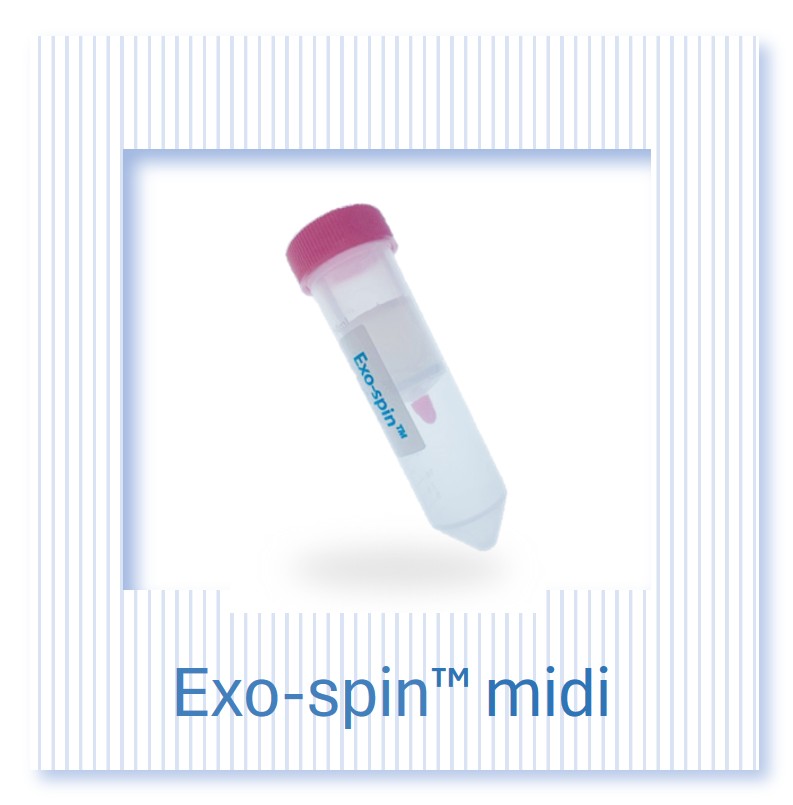
| Exo-spin SEC Kits — Cell Guidance Systems |
| Exo-spin SEC isolation kits are optimised to isolate EVs and exosomes in the 30-250 nm size range. The resin has been specifically selected to maximise EV recovery while excluding free proteins and smaller particles. Exo-spin is available in midi and mini formats for a range of sample volumes, and has been cited in peer-reviewed EV research across multiple sample types including cell culture media, plasma and urine. View Exo-spin kits at cellgs.com |
Advantages
- High purity: SEC consistently produces EV preparations with lower protein contamination than UC. The physical separation principle means only particles in the 30-250 nm range elute in the EV fraction.
- Preserves EV integrity: The gentle, gravity-driven separation does not apply mechanical stress to vesicles. Surface proteins and membrane-associated cargo are preserved, which is essential for functional and biomarker studies.
- Speed: A complete Exo-spin isolation takes approximately 30-60 minutes compared to 4-6 hours for UC, enabling same-day processing of multiple samples.
- No specialist equipment: Exo-spin requires only a standard bench-top centrifuge, making it accessible to any laboratory regardless of equipment budget.
- MISEV recommended: SEC is explicitly recommended in MISEV guidelines as a high-quality isolation method, which simplifies the characterisation and publication workflow.
- Compatible with downstream NTA, western blot and ExoLISA assays without additional clean-up steps
Limitations
- Not designed for very large sample volumes (above 500 ml): TFF is better suited for this scale
- Eluted EV fraction is typically diluted relative to the input, which may require downstream concentration for some assays
- Column resin has a finite capacity: very high-particle-number samples may require pre-dilution
| Bottom Line: SEC |
| The preferred method for most laboratory-scale EV research. Exo-spin kits provide a fast, reproducible, MISEV-compatible isolation without ultracentrifugation. Recommended as the default isolation method for samples up to 500 ml. |
3. Tangential Flow Filtration (TFF)
How it works
TFF passes a sample tangentially across a semi-permeable membrane under pressure. Small molecules, free proteins and debris pass through the membrane as filtrate, while EVs are retained and concentrated above the membrane. Unlike dead-end filtration (which clogs), the tangential flow continuously sweeps the membrane surface, enabling processing of large volumes without filter fouling. The process is continuous rather than batch-based, making it highly scalable.
| EVlution TFF System — Cell Guidance Systems |
| EVlution is an affordable bench-top TFF system designed specifically for EV isolation and concentration. The innovative Switch Flow technology reduces the processed sample to a final output volume of under 10 ml, making it ideal for downstream analysis by NTA, western blot or ExoLISA. EVlution is the first TFF system designed to make tangential flow filtration accessible to any research laboratory, removing the cost and complexity barriers that previously limited TFF to industrial-scale applications. View EVlution TFF at cellgs.com |
Advantages
- High-volume processing: TFF is the method of choice when working with large conditioned media volumes (50 ml to several litres). EVlution can process volumes that would require multiple sequential SEC columns or multiple UC runs.
- High yield: Because TFF is a retention method rather than a size exclusion method, EVs of all sizes above the membrane cut-off are retained, giving very high particle yields.
- Concentration and isolation in one step: EVlution simultaneously removes small contaminants and concentrates the EV fraction to under 10 ml, which is immediately compatible with downstream analytical methods.
- Gentle processing: The low-shear tangential flow preserves EV membrane integrity and surface protein expression, similar to SEC.
- Scalable for production-level applications, including EV product formulation and freeze drying workflows
- MISEV compatible and increasingly cited in translational and clinical EV research
Limitations
- Higher upfront equipment cost than SEC columns, though EVlution is priced to be accessible to academic laboratories
- Membrane cut-off selection requires optimisation for different sample types
- Less selective by size than SEC: smaller contaminants near the membrane cut-off may co-concentrate with EVs
| Bottom Line: TFF |
| The method of choice for large-volume samples, production-scale EV work, and any workflow requiring maximum yield. EVlution brings TFF to the bench at a price point accessible to research laboratories for the first time. |
Method Comparison at a Glance
| Parameter | Ultracentrifugation | SEC (Exo-spin) | TFF (EVlution) |
|---|---|---|---|
| Purity | Moderate (protein contamination common) | High (separates by size, >95% purity) | High (retains EVs, removes free protein) |
| Yield | High | Moderate to high | High |
| Throughput | Low (1 sample at a time) | High (96-well formats available) | High (continuous flow) |
| Equipment | Ultracentrifuge (expensive, specialist) | None beyond bench centrifuge | TFF system (bench-top) |
| Time | 4-6 hours | 30-60 minutes | 1-2 hours |
| Sample volume | 10 ml to 500 ml | 0.1 ml to 500 ml | 50 ml to several litres |
| EV integrity | Can damage EVs at high g-force | Excellent: gentle SEC separation | Excellent: low-shear filtration |
| MISEV compatible | Yes (with caveats) | Yes: recommended | Yes: recommended |
| CGS product | N/A | Exo-spin SEC kits | EVlution TFF system |
Which Method is Right for Your Experiment?
The choice of isolation method should be driven by your sample type, required purity, downstream application and available resources.
Choose Exo-spin SEC if:
- Your sample volume is between 0.1 ml and 500 ml
- You need high-purity EVs for biomarker studies, western blot or functional assays
- You want a fast, reproducible workflow without specialist equipment
- You are working toward MISEV-compliant characterisation for publication
- You are new to EV research and want a reliable, well-cited starting method
Choose EVlution TFF if:
- You are processing large conditioned media volumes (50 ml to several litres)
- Maximising EV yield is the primary requirement
- You need EVs concentrated to a small volume for downstream analysis
- You are developing an EV product and need a scalable, reproducible concentration step
- You want to combine isolation with freeze drying for long-term EV storage
Consider ultracentrifugation if:
- You already have an ultracentrifuge and an established UC protocol
- Your downstream assays are tolerant of moderate protein co-isolation
- You are directly comparing your results with legacy UC datasets
Combining SEC and TFF for Maximum Performance
For the highest purity and yield, SEC and TFF can be used in sequence. A typical combined workflow uses EVlution TFF to process a large conditioned media volume and concentrate EVs to under 10 ml, followed by Exo-spin SEC polishing to remove residual protein contamination from the concentrated fraction. The resulting preparation combines the high yield of TFF with the high purity of SEC.
This combined approach is particularly well suited to translational research applications where both yield and purity are critical, such as EV biomarker discovery from large plasma volumes or the production of EVs for functional in vivo studies.
Outsourced EV Isolation and Analysis Services
For laboratories requiring EV isolation without the time or resource investment of an in-house workflow, Cell Guidance Systems offers a complete outsourced EV isolation and characterisation service. Our EV Basic Service Package includes Exo-spin SEC isolation, BCA protein quantification and ZetaView NTA analysis, typically returned within 1-2 weeks of sample receipt.
Our EV MISEV Service Package extends the Basic package with lipid quantification, western blot for CD9/CD63/CD81 tetraspanin biomarkers and ExoLISA biomarker detection assays, providing a fully MISEV-compliant characterisation dataset for publication.
Standalone NTA particle analysis and EV freeze drying services are also available for laboratories that have completed their own isolation.
| Request a Quote |
| To discuss your EV isolation or characterisation requirements, contact the Cell Guidance Systems scientific team at cellgs.com/evexosome-service-enquiry or email [email protected] |
Conclusion
Ultracentrifugation has served the EV field for decades, but the limitations of co-pelleting, low throughput and equipment requirements have driven adoption of newer methods. SEC using Exo-spin kits and TFF using EVlution now provide faster, higher-purity, MISEV-compatible alternatives that are accessible to any research laboratory.
For most laboratory-scale EV research, Exo-spin SEC is the recommended starting point. For large-volume or production-scale work, EVlution TFF provides unmatched throughput. The two methods are complementary and can be combined for workflows requiring both maximum yield and maximum purity.
Cell Guidance Systems provides both isolation products and a complete outsourced EV service, supporting laboratories from their first exosome experiment through to translational and clinical research programmes.
IMAGE EV purification methods CDREDIT Cell Guidance Systems
Learn more about powerful technologies that are enabling research: