Isolating EVs at Scale: A Guide to Tangential Flow Filtration

In our recent comparison of exosome isolation methods, we outlined the core differences between ultracentrifugation, size exclusion chromatography and tangential flow filtration, and explained why SEC and TFF are increasingly favoured over traditional ultracentrifugation for most research workflows. If you have not read that article, it provides a useful starting point: UC vs SEC vs TFF: Exosome and EV Isolation Methods Compared.
This article goes deeper on tangential flow filtration: what it is, how it works at a mechanistic level, when it should be your method of choice, and how to optimise a TFF-based workflow for consistent, high-yield EV isolation at scale.

Key Point |
|
Tangential flow filtration is the method of choice when sample volume, yield and scalability are the primary requirements. It is the only isolation approach that can process litre-scale conditioned media volumes in a single continuous run without filter fouling, and it simultaneously concentrates EVs to a small, analytically ready output volume. |
What Is Tangential Flow Filtration?
Tangential flow filtration (TFF) is a membrane-based separation technique in which the sample is pumped across the surface of a semi-permeable membrane rather than through it. This is the fundamental distinction between TFF and conventional dead-end filtration.
In dead-end filtration, fluid is forced directly through the membrane. Retained material accumulates on the membrane surface, progressively increasing resistance and eventually causing the filter to clog. This limits the volume that can be processed and makes dead-end filtration impractical for large-scale EV isolation.
In TFF, the tangential flow sweeps the membrane surface continuously. This sweeping action removes retained material and prevents cake formation, allowing the process to continue at a stable flux rate for as long as sample is available. Large volumes can be processed without interruption, and the output concentration increases progressively as small molecules and solvent are removed as filtrate (permeate).
The Two Streams in TFF
At any point during a TFF run, the system manages two streams simultaneously:
Retentate: The fraction retained above the membrane. For EV isolation, this is the fraction of interest. Particles larger than the membrane molecular weight cut-off (MWCO), including EVs, microvesicles and large protein complexes, are retained and progressively concentrated.
Permeate (filtrate): The fraction that passes through the membrane and is discarded. This includes free proteins, small molecules, cell culture media components (phenol red, antibiotics, growth factors) and solvent.
By selecting a membrane with an appropriate MWCO, typically in the 100 kDa to 500 kDa range for EV isolation, free proteins and media components are efficiently removed while EVs are retained and concentrated.
Why Scale Matters for EV Research
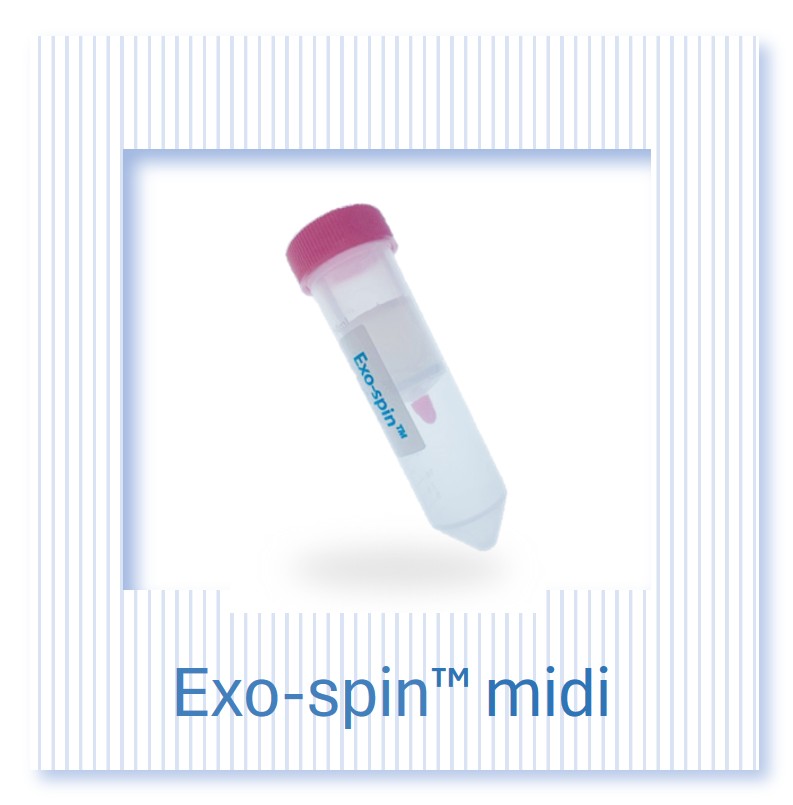
Many EV workflows in the literature are optimised for small sample volumes: 1-10 ml of plasma, or a 10 cm dish of conditioned media. At this scale, SEC using Exo-spin kits is typically the most practical and efficient approach, delivering high-purity EVs in under an hour with no specialist equipment.
The need for TFF arises when scale increases. Common scenarios include:
Large conditioned media volumes. Cell lines secreting EVs at physiologically relevant concentrations typically require 200 ml to several litres of conditioned media to yield sufficient particle numbers for downstream functional, proteomic or RNA cargo studies. Processing this volume by SEC would require tens of columns run in sequence. TFF processes the entire volume in a single continuous run.
EV product development. Laboratories developing EV-based therapeutics, drug delivery vehicles or reference standards need not only large quantities of EVs but also a scalable, reproducible process. TFF provides both, and the unit operations are directly transferable from bench to pilot scale.
Freeze-drying workflows. Producing freeze-dried EV preparations for long-term storage or distribution requires a concentrated, protein-depleted EV suspension as the input. TFF is ideally positioned upstream of a lyophilisation step, generating a concentrated retentate ready for direct freeze drying.
Biomarker discovery from biofluids. Large-volume plasma or urine processing for biomarker discovery requires an isolation method that is both scalable and yield-preserving. TFF retains EVs of all sizes above the membrane cut-off, maximising recovery compared to size exclusion approaches that may have narrower particle capture windows.
How EVlution TFF Works
EVlution TFF System — Cell Guidance Systems |
|
EVlution is a bench-top TFF system designed specifically for EV isolation, concentration and purification. Its innovative Switch Flow technology reduces processed sample to a final output volume of under 10 ml, making it directly compatible with downstream NTA, western blot, ExoLISA assays and freeze drying. EVlution is the first TFF system designed to make tangential flow filtration genuinely accessible to academic research laboratories, removing the cost and complexity barriers that previously limited TFF to industrial biomanufacturing settings. |
EVlution uses a hollow-fibre membrane cartridge through which the sample is recirculated in a closed loop. As the run progresses, permeate is continuously removed and discarded, while the retentate volume decreases. The Switch Flow mechanism allows the system to efficiently recover the concentrated retentate at run completion, minimising EV loss at the final concentration step.
A typical EVlution workflow proceeds as follows:
1. Sample preparation. Conditioned media is clarified by low-speed centrifugation (300-500 x g, 5 minutes) to remove cells and large debris, followed by an intermediate spin (2,000-3,000 x g, 10 minutes) to pellet dead cells and large apoptotic bodies. The clarified supernatant is the TFF input.
2. System priming. The hollow-fibre cartridge is equilibrated with PBS or the appropriate buffer. This removes storage solution and ensures the membrane surface is ready for processing.
3. Concentration and diafiltration. The clarified media is loaded into the EVlution reservoir and the pump is started. The system runs continuously, removing permeate and reducing the retentate volume. For maximum protein depletion, a diafiltration step can be introduced: PBS or buffer is added to the retentate during the run to wash free proteins across the membrane without diluting the EV concentration. Diafiltration is particularly valuable when processing serum-containing media, where residual albumin and other abundant proteins can interfere with downstream characterisation.
4. Final concentration. Switch Flow is engaged to recover the concentrated retentate, typically to under 10 ml regardless of the starting volume. This output is immediately ready for NTA particle analysis, protein quantification, western blot for tetraspanin biomarkers (CD9, CD63, CD81) or ExoLISA assay.
Membrane Selection: Choosing the Right MWCO
The membrane molecular weight cut-off determines which components are retained and which pass through as permeate. For EV isolation, the key consideration is the trade-off between EV retention and protein clearance.
Membrane MWCO Selection Guide for EV Isolation |
||
| MWCO | Retained above membrane | Passes as permeate |
| 100 kDa | EVs, large protein complexes, some HDL | Free proteins below ~100 kDa, small molecules, salts |
| 300 kDa | EVs, large vesicle-associated protein complexes | Most free proteins, including albumin (67 kDa) |
| 500 kDa | EVs, larger co-isolates | Free proteins, smaller lipoprotein fractions |
100 kDa MWCO is the most widely used for EV isolation. It provides robust EV retention across the full exosome and microvesicle size range (30 nm to 1,000 nm) while removing the majority of free proteins. Some high-molecular-weight protein aggregates may co-concentrate with EVs at this cut-off, which can be addressed by a downstream SEC polishing step.
300 kDa MWCO provides better protein clearance and is particularly useful when processing serum or plasma, where high-abundance proteins (albumin, IgG, fibrinogen) present significant contamination risk. Particle recovery remains high at this cut-off because even the smallest exosomes (30-50 nm) are large relative to 300 kDa.
500 kDa MWCO is used in applications where maximum protein clearance is required and the focus is on larger EV populations (100 nm and above). This cut-off is less common for standard exosome isolation but may be appropriate for specific biofluid types.
Practical Guidance |
|
For cell culture conditioned media processed in serum-free or low-serum conditions, 100 kDa MWCO is the standard starting point. For plasma or serum-containing media, consider 300 kDa MWCO combined with diafiltration for maximum protein clearance. |
Optimising Your TFF Workflow
Transmembrane Pressure
Transmembrane pressure (TMP) is the pressure difference across the membrane and is the primary driver of permeate flux. Higher TMP increases flux (faster processing) but also increases the risk of protein concentration polarisation at the membrane surface, which can reduce EV recovery. For EV isolation, TMP should be kept in the low-to-moderate range (typically 0.5-1.5 bar). EVlution is designed to operate within this range at standard pump settings, removing the need for manual pressure optimisation in most workflows.
Flow Rate and Shear
The tangential flow rate across the membrane surface determines the shear stress applied to EVs in the retentate loop. Insufficient flow allows retained material to accumulate on the membrane (concentration polarisation), reducing flux and recovery. Excessive flow generates mechanical shear that can damage EV membranes. EVlution is pre-optimised for the flow rates appropriate for EV isolation, balancing membrane clearance against EV integrity.
Buffer Composition
Standard TFF buffers for EV isolation are PBS (pH 7.4) or HEPES-buffered saline. Avoid buffers containing detergents, reducing agents or high concentrations of chaotropic salts, as these may compromise EV membrane integrity or interfere with downstream assays. For applications requiring specific storage conditions, the buffer can be exchanged during the diafiltration step by adding the target buffer to the retentate loop.
Diafiltration Volume
Diafiltration efficiency depends on the number of volume exchanges performed. A common recommendation is 5-10 diafiltration volumes (5-10 times the retentate volume added as buffer and removed as permeate). For plasma processing with 300 kDa MWCO, 5 volume exchanges typically removes greater than 95% of albumin from the retentate.
Post-run Recovery
EV adsorption to hollow-fibre membranes can reduce recovery if the system is not flushed correctly at run completion. EVlution Switch Flow technology is designed to minimise this loss, but a brief buffer flush of the cartridge at run completion will recover any residual EVs from the dead volume.
TFF Followed by SEC: The Combined Workflow
For applications requiring both maximum yield and maximum purity, TFF and SEC can be used in sequence. This combined approach is particularly well suited to:
- EV biomarker discovery from large plasma volumes
- Preparation of highly pure EVs for proteomic or lipidomic cargo analysis
- Production of EVs for in vivo functional studies where protein contamination may confound results
- Reference standard production for assay development
The combined workflow is straightforward:
Step 1: Process the large-volume sample (conditioned media or clarified plasma) through EVlution TFF. This reduces the volume to under 10 ml and removes the majority of free proteins and small molecules.
Step 2: Apply the concentrated retentate to Exo-spin SEC columns for size-based polishing. This removes residual protein contamination and co-concentrated large protein complexes, producing a high-purity EV fraction in the 30-250 nm size range.
The resulting preparation combines the throughput advantage of TFF with the purity advantage of SEC. It is MISEV-compatible and directly suitable for downstream characterisation by NTA, western blot, ExoLISA and mass spectrometry without further clean-up.
Exo-spin SEC Kits — Cell Guidance Systems |
|
Exo-spin SEC isolation kits are optimised for EV isolation in the 30-250 nm size range and are compatible with TFF-concentrated inputs. Available in midi and mini formats for a range of sample volumes. |
Characterising Your TFF-Isolated EVs
MISEV2023 guidelines recommend a minimum characterisation dataset for any EV preparation intended for publication. For TFF-isolated EVs, the following measurements are recommended:
Nanoparticle Tracking Analysis (NTA): Quantifies particle concentration and size distribution, confirming the presence of vesicles in the 30-250 nm range and providing the particle-to-protein ratio required by MISEV guidelines. Cell Guidance Systems provides a standalone NTA particle analysis service for laboratories that have completed in-house isolation.
Western blot for tetraspanin markers: Detection of CD9, CD63 and CD81 confirms the EV identity of the preparation. These are the three positive markers specified in MISEV guidelines. EVlution-isolated preparations consistently show positive tetraspanin expression by western blot.
ExoLISA biomarker assays: Cell Guidance Systems ExoLISA assays provide quantitative ELISA-based detection of CD9, CD63 and CD81, offering a faster and more quantitative alternative to western blot for tetraspanin characterisation.
Protein quantification (BCA assay): Total protein content in the EV preparation provides the denominator for particle-to-protein ratio calculations. Lower ratios indicate higher-purity preparations.
Negative marker assessment: MISEV guidelines recommend confirming the absence of abundant non-EV proteins, for example albumin from serum-containing media or endoplasmic reticulum markers such as calnexin, to validate that the preparation is not contaminated with non-vesicular material.
Outsourced TFF and EV Services
For laboratories without in-house TFF capability, Cell Guidance Systems offers a complete outsourced EV isolation and characterisation service. Our EV Basic Service Package includes Exo-spin SEC isolation, BCA protein quantification and ZetaView NTA analysis. Our EV MISEV Service Package extends this with lipid quantification, tetraspanin western blot and ExoLISA biomarker detection, providing a fully MISEV-compliant characterisation dataset for publication.
For large-volume samples appropriate for TFF processing, please contact our scientific team to discuss your requirements. We can advise on the most appropriate workflow for your sample type and downstream application.
Request a Quote |
|
To discuss EV isolation or characterisation requirements, contact the Cell Guidance Systems scientific team at cellgs.com/evexosome-service-enquiry or email [email protected] |
Summary: When to Choose TFF
Choosing the Right EV Isolation Method |
|
| Scenario | Recommended Approach |
| Small volume (0.1-50 ml), high purity needed | Exo-spin SEC |
| Large volume (50 ml to several litres), maximum yield | EVlution TFF |
| Large volume, maximum yield AND maximum purity | EVlution TFF followed by Exo-spin SEC |
| EV product development or freeze drying | EVlution TFF |
| Plasma biomarker discovery at scale | EVlution TFF (300 kDa MWCO) with diafiltration |
| MISEV-compliant characterisation for publication | Either SEC or TFF, with full tetraspanin and NTA dataset |
Tangential flow filtration has historically been associated with industrial bioprocessing. EVlution changes that equation by bringing TFF to the research bench at an accessible price point, with a workflow optimised specifically for EV isolation rather than adapted from protein or antibody manufacturing processes. For any laboratory working with large conditioned media volumes, developing EV products, or requiring maximum particle yield, EVlution TFF is the most effective single-instrument solution available.
Related Cell Guidance Systems Products and Services
- EVlution TFF system
- Exo-spin SEC isolation kits
- ExoLISA biomarker assays (CD9, CD63, CD81)
- EV and Exosome Services
- NTA Particle Analysis Service
- EV Freeze Drying Service
- EV Basic Service Package
- EV MISEV Service Package
IMAGE EV purification methods CDREDIT Cell Guidance Systems
Learn more about powerful technologies that are enabling research: