Using TFF and SEC for purifying viruses and VLPs

Tangential flow filtration (TFF) and size exclusion chromatography (SEC) have emerged as the two workhorses of virus and virus-like particle (VLP) purification, and for good reason. Each technique exploits a different physical property of the particle, and when applied in sequence they deliver a combination of concentration, buffer exchange, and resolution that neither method achieves alone. Understanding how to deploy them together, and where each one can fail, is increasingly important as gene therapy vectors, vaccine candidates, and VLP-based drug delivery systems move through development and into manufacturing scale.
| Key Point |
| TFF concentrates and diafilters virus or VLP preparations in a single step, removing small-molecule impurities while retaining particles in the retentate. SEC then resolves particles from aggregates and co-purifying protein contaminants on the basis of hydrodynamic size. Used together, the two steps produce material that is concentrated, formulated, and chromatographically purified, ready for downstream analytical characterisation or fill-finish operations. |
Why Particle Size Matters for Method Selection
Viruses and VLPs span a wide size range, from small non-enveloped particles such as adeno-associated virus (AAV) at approximately 25 nm up to large enveloped viruses approaching 300 nm or more. This size range sits in a productive middle ground for both TFF and SEC: large enough to be retained by hollow fibre membranes with molecular weight cut-offs (MWCO) in the 100 to 750 kDa range, but small enough to enter the pores of appropriately chosen SEC resins.
The same size range creates challenges. Particles in the 50 to 200 nm window are too large to be purified efficiently by ion exchange or affinity chromatography without significant risk of shear-induced aggregation on resin beads, and too variable in surface chemistry across different constructs to make a single affinity ligand universally applicable. TFF and SEC sidestep the surface chemistry problem entirely: they separate by size and hydrodynamic behaviour rather than by charge or receptor binding, making them broadly applicable across virus families and VLP compositions.
Tangential Flow Filtration: Principles and Process Design
In TFF, feed material is pumped across the surface of a membrane rather than through it. Transmembrane pressure drives small molecules and solvent through the membrane as permeate, while particles and macromolecules above the membrane MWCO are retained in the retentate and recirculated. Because the tangential flow continuously sweeps the membrane surface, concentration polarisation and fouling are substantially reduced compared to dead-end filtration, allowing high flux to be maintained over extended process times.
For virus and VLP applications, a hollow fibre membrane with an MWCO of 100 to 500 kDa is typically chosen. This retains particles while passing host cell proteins below approximately 100 to 150 kDa, nucleic acid fragments, culture media components, and small-molecule additives. The process proceeds in two phases:
Concentration. The retentate volume is reduced by a defined factor, typically 5 to 20-fold depending on the starting titre and target concentration. This step recovers particles from large volumes of clarified harvest, dramatically reducing the volume that must be handled in subsequent chromatography steps.
Diafiltration. Once concentrated, the retentate is exchanged into a defined formulation buffer by continuous addition of fresh buffer as permeate is removed. Diafiltration removes residual media components, reduces conductivity ahead of any ion exchange step, and begins the transition into a buffer compatible with SEC or final formulation. Seven to ten diavolumes reduces small-molecule impurity concentrations by more than 99.9%.
| Key TFF Operating Parameters for Virus and VLP Purification | ||
| Parameter | Typical range | Key consideration |
| Membrane MWCO | 100 to 750 kDa | Lower MWCO retains more host cell protein; higher MWCO allows faster flux but may pass larger impurities |
| Transmembrane pressure (TMP) | 0.5 to 2.0 bar | Excess TMP causes membrane fouling and particle aggregation; operate in the pressure-independent flux regime |
| Cross-flow rate | 6 to 8 LMH per bar | Higher cross-flow reduces fouling but increases shear; titrate carefully for enveloped particles |
| Concentration factor | 5 to 20-fold | Excessive concentration increases aggregation risk; define upper limit empirically for each construct |
| Diafiltration volumes | 7 to 10 diavolumes | Sufficient to reduce small-molecule impurity levels by more than three logs |
| Temperature | 4 to 8 degC (preferred) | Reduces aggregation and protease activity; requires temperature-controlled pump and reservoir |
Common TFF Failure Modes and How to Avoid Them
Membrane fouling. Fouling is the primary cause of flux decline and particle loss in TFF. It arises from adsorption of host cell proteins, DNA, and lipids onto the membrane surface, and from concentration polarisation at high TMP. Prevention starts with clarification: a centrifugation or depth filtration step ahead of TFF to remove cell debris significantly reduces the fouling load. Operating at the lowest TMP that maintains acceptable flux and using a membrane with appropriate surface chemistry for the feed material also reduces fouling. Polyethersulfone (PES) membranes are widely used for viral applications; modified cellulose membranes can offer lower protein binding for particularly sensitive constructs.
Particle aggregation. Aggregation during TFF is driven by high local particle concentrations at the membrane surface, excessive shear at high cross-flow rates, and suboptimal buffer composition. Enveloped viruses are particularly susceptible. Stabilising the feed with sucrose at 5 to 10% (w/v) or trehalose at 2 to 5% (w/v) before TFF reduces aggregation, as does including a non-ionic surfactant such as polysorbate 80 at 0.001 to 0.01% where the construct tolerates it. Monitoring retentate particle size distribution by dynamic light scattering (DLS) at intervals during the run allows aggregation to be detected before it becomes irreversible.
Particle loss through the membrane. Particles close to the membrane MWCO, particularly for smaller non-enveloped viruses and compact VLPs, can pass into the permeate at appreciable rates. Selecting a membrane with a retention cut-off comfortably below the particle hydrodynamic diameter, and confirming retention empirically by measuring both retentate and permeate titres during development runs, is essential before committing to a process.
Size Exclusion Chromatography: Principles and Resin Selection
SEC separates molecules and particles by their hydrodynamic radius as they migrate through a porous resin bed. Larger species that cannot enter the resin pores travel through the interstitial volume and elute first. Smaller species that partition into the pores are retarded and elute later. For virus and VLP purification, SEC is applied primarily to remove two categories of impurity that TFF cannot resolve: aggregated particles (which elute ahead of intact particles at the void volume) and monomeric protein contaminants such as bovine serum albumin, capsid assembly intermediates, and residual host cell proteins that TFF has not eliminated.
Resin selection for viral SEC is driven by particle size and the need to achieve adequate resolution from contaminants within an acceptable run volume. The principal options are:
| SEC Resin Options for Virus and VLP Applications | |||
| Resin type | Fractionation range | Best suited to | Key limitation |
| Sepharose CL-4B / CL-2B | 1 x 10⁴ to 4 x 10⁷ Da | Large enveloped viruses (100 to 300 nm); EV purification | Low back-pressure tolerance; gravity-flow only at preparative scale |
| Superose 6 | 5 x 10³ to 4 x 10⁷ Da | Small to medium VLPs (20 to 100 nm); AAV; analytical SEC | Limited preparative capacity; expensive per run at large scale |
| Capto Core 700 | Excludes particles above 700 kDa | High-throughput polishing; particles elute in void volume | Relies on size exclusion plus multimodal core binding; not true SEC |
| Sephacryl S-500 / S-1000 | 104 to 108 Da | Preparative scale polishing; moderate back-pressure tolerance | Lower resolution than Superose; longer run times at equivalent column volumes |
Integrating TFF and SEC: Process Sequence and Critical Interfaces
The standard process sequence is TFF first, SEC second. TFF reduces the sample volume to a fraction that can realistically be loaded onto an SEC column without overloading it, and diafiltration exchanges the sample into a buffer compatible with the SEC mobile phase. Loading a large, poorly buffered volume onto an SEC column disrupts the separation and risks precipitating particles at the column inlet.
The load volume for preparative SEC should not exceed 2 to 5% of the total column volume for resolution-critical applications, and 10% for polishing steps where only gross contaminant removal is required. For a 320 ml column, this means the TFF retentate must be concentrated to no more than 6 to 32 ml before loading. Matching TFF concentration targets to SEC column dimensions at the design stage avoids discovering this constraint late in development.
The diafiltration buffer should match the SEC mobile phase in composition, pH, and ionic strength. A mismatch creates a discontinuity at the sample-buffer interface inside the column, generating artefactual peak broadening and in severe cases causing irreversible particle aggregation at the column head. PBS pH 7.4 with added sucrose at 5% (w/v) is a common formulation buffer that is compatible with most SEC resins and provides adequate stabilisation for non-enveloped viruses and many VLPs during the chromatography step.
Flow rate on the SEC column is a critical parameter that is often overlooked. Viral particles are large and diffuse slowly; if the linear flow rate is too high they do not equilibrate fully between the mobile phase and the stationary phase pores, and resolution collapses. Reducing the linear flow rate to 0.1 to 0.3 column volumes per minute, substantially lower than what would be used for protein SEC, typically recovers lost resolution.
Analytical SEC as a Process Development Tool
Analytical SEC on a high-resolution column such as a Superose 6 Increase 10/300 GL is one of the most informative tools available during process development for virus and VLP purification. Run in-line with a UV detector at 260 and 280 nm, it provides a rapid readout of three critical parameters that would otherwise require separate assays:
The ratio of absorbance at 260 nm to 280 nm reports on the nucleic acid content of the particles eluting at each retention volume. A ratio above 1.3 indicates particles with encapsidated nucleic acid, while empty capsids and protein aggregates have ratios closer to 0.5 to 0.8. Tracking this ratio across fractions allows full and empty particle populations to be distinguished without requiring upstream ultracentrifugation for initial characterisation.
The peak symmetry and width report on aggregation. A leading shoulder on the main particle peak, eluting at lower retention volumes, indicates aggregated material co-eluting partially with intact particles. Progressive broadening across replicate runs on the same sample suggests ongoing aggregation in the retentate between TFF and SEC, pointing to a buffer or temperature problem at the TFF-to-SEC handoff.
The late-eluting protein baseline identifies residual host cell proteins and free capsid protein remaining after TFF. The area under this late-eluting region, expressed as a fraction of the total peak area, is a useful semi-quantitative guide to polishing performance that correlates with more resource-intensive assays such as host cell protein ELISA.
Scale Considerations and the Role of Hollow Fibre TFF Systems
One of the practical advantages of TFF over ultracentrifugation, the traditional workhorse for virus purification, is that it scales predictably. Increasing membrane area while holding TMP, cross-flow velocity, and concentration factor constant maintains process performance across scales, enabling direct transfer from laboratory to manufacturing without full re-optimisation. Ultracentrifugation, by contrast, does not scale proportionally: run time, rotor geometry, and gradient behaviour all change with scale in ways that require extensive re-validation.
The EVlution TFF system from Cell Guidance Systems is designed specifically for the research and early development scale where the practical limitations of ultracentrifugation are most acutely felt: insufficient throughput for repeated development runs, high per-run cost, and the need for trained operators and specialist equipment. EVlution TFF uses peristaltic pump-driven hollow fibre filtration with integrated pressure monitoring, enabling reproducible TFF runs at the 10 to 500 ml scale without the capital cost or operational complexity of centrifuge-based concentration. For groups developing virus or VLP purification processes at the bench, this scale is the one at which membrane selection, concentration factors, and diafiltration buffer conditions are empirically determined, and reproducibility at this stage directly determines whether the process will transfer successfully to manufacturing scale.
| TFF vs Ultracentrifugation for Virus and VLP Concentration | ||
| Attribute | TFF | Ultracentrifugation |
| Scalability | Linear with membrane area; well-characterised scale-up rules | Non-linear; rotor geometry and gradient behaviour change with scale |
| Buffer exchange | Integrated via diafiltration in the same step | Requires separate dialysis or desalting step after pelleting |
| Process closure | Closed system; compatible with aseptic processing | Open at resuspension step; biocontainment risk for high-titre preparations |
| Throughput | High; continuous process with no rotor capacity constraint | Limited by rotor volume; requires multiple runs for large volumes |
| Equipment cost | Moderate; bench-scale systems accessible for most labs | High; ultracentrifuge and rotors represent a significant capital investment |
| Shear sensitivity | Moderate; optimise cross-flow rate for enveloped particles | High shear during pelleting and resuspension can damage enveloped particles |
Monitoring Purity and Integrity After TFF and SEC
A purification process is only as good as the analytical tools used to assess it. For virus and VLP preparations, the following measurements together provide a complete picture of the material coming off the SEC column:
Particle number and size. Nanoparticle tracking analysis (NTA) or tunable resistive pulse sensing (TRPS) measures the particle size distribution and absolute particle concentration in the eluate. This confirms that the SEC peak corresponds to intact particles of the expected diameter and gives the particle-per-millilitre titre needed for subsequent dose calculations.
Protein purity. SDS-PAGE with silver staining or SYPRO Ruby fluorescent staining resolves individual protein species to a sensitivity of 1 to 10 ng per band. For VLPs, the expected banding pattern of structural proteins should dominate, with no extraneous bands that would indicate residual host cell proteins or process-related impurities.
Nucleic acid content. Residual DNA is a regulatory concern for viral vectors and VLP-based therapeutics. A sensitive fluorometric assay (PicoGreen for double-stranded DNA; RiboGreen for RNA) or qPCR for specific host cell sequences quantifies the residual nucleic acid level in the final eluate against regulatory acceptance criteria.
Functional integrity. Biophysical purity does not guarantee biological activity. A cell-based transduction assay for viral vectors, or a receptor binding assay for VLPs carrying surface ligands, confirms that the purification process has not inactivated the particle through denaturation, aggregation, or loss of surface-displayed epitopes.
A Note on VLP-Specific Considerations
VLPs present additional process design considerations that differ from native viruses. Because VLPs lack a genome, they cannot be quantified by infectivity assays, and the distinction between full and empty particles is less straightforward. For VLPs assembled from recombinant proteins, the assembly process itself may leave a distribution of oligomeric states, partially assembled capsomeres, and free protein subunits in the feed material. TFF cannot distinguish between these species on the basis of size alone if their hydrodynamic diameters overlap. SEC is therefore especially important in VLP purification, both as a polishing step and as an analytical tool for confirming assembly state.
For VLPs carrying a cargo molecule, whether nucleic acid, small molecule drug, or imaging agent, an additional concern is the fraction of particles that have successfully encapsidated their payload. Analytical SEC coupled to fluorescence detection at the cargo excitation wavelength, or AUC (analytical ultracentrifugation) to resolve loaded and unloaded particles by sedimentation coefficient, provides this information at the development stage before committing to a preparative run.
Exo-spin Columns as a Convenient Small-Scale SEC Option
For groups working at small scale, whether in early VLP process development or in analytical characterisation of purified fractions, preparative SEC on a column system is not always the most practical starting point. Setting up and validating an SEC column run requires equipment, time, and a sufficient sample volume to occupy a meaningful fraction of the column bed. At the microlitre to low-millilitre scale, a spin column format based on the same size exclusion principle can serve the same purpose with considerably less overhead.
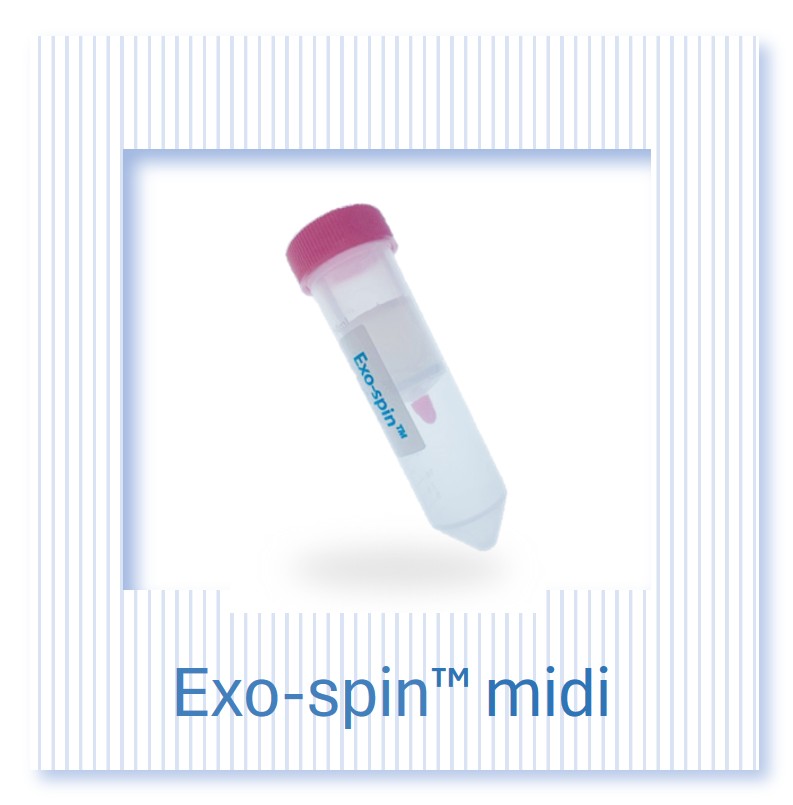
Exo-spin columns from Cell Guidance Systems use a size exclusion resin in a centrifuge-compatible spin column format, designed to separate particles in the extracellular vesicle size range from soluble proteins and small-molecule contaminants. EVs and VLPs occupy a very similar size range, typically 30 to 200 nm, and the physical basis of separation is the same: particles too large to enter the resin pores are excluded and elute ahead of smaller species that partition into the pore volume.
We do not have published data specifically validating Exo-spin columns for VLP purification, and groups using them for this purpose should generate their own recovery and purity data for their specific construct. What can be said on the basis of the underlying size exclusion principle is that VLPs in the 30 to 200 nm range are expected to behave comparably to EVs of equivalent diameter during spin column SEC, provided the sample has been pre-clarified and is in a buffer compatible with the resin. The spin column format offers a practical advantage in this context: the entire workflow from sample loading to eluate collection takes under 30 minutes, requires only a benchtop centrifuge, and consumes sample volumes of 0.5 to 1.0 ml, making it well suited to the rapid analytical turnaround needed during process development.
A reasonable workflow for small-scale VLP work is to use Exo-spin columns for initial characterisation runs and method scouting, and to transfer to a preparative SEC column once the process parameters are defined and larger quantities of purified material are needed. The two formats are complementary in the same way that TFF and SEC are complementary at the preparative scale: each has a regime where it is the most efficient tool.
Conclusion
TFF and SEC are complementary, not competing, techniques. TFF delivers concentrated, buffer-exchanged material efficiently and at scale; SEC resolves the remaining impurities that TFF cannot address. Designing the interface between the two steps, the concentration target, the diafiltration buffer, and the load volume, is where most of the development effort pays off. A process that handles this interface well produces material that is reproducibly pure, intact, and amenable to quantitative analytical characterisation, which is the foundation for any meaningful downstream biology or regulatory submission.
For research groups building their first virus or VLP purification process, the EVlution TFF system provides a practical entry point to TFF at the scale where process parameters are defined. Paired with SEC, it enables a fully chromatographic purification workflow that is characterisable, transferable, and free from the scale and throughput constraints of ultracentrifugation.
Explore EVlution TFF for Virus and VLP Purification
EVlution TFF System. Bench-scale hollow fibre tangential flow filtration system designed for reproducible concentration and diafiltration of extracellular vesicles, viruses, and VLPs. View EVlution TFF.
Exo-spin Columns. Size exclusion spin columns for small-scale particle purification and analytical characterisation in the EV and VLP size range. No column system required. View Exo-spin.
EV and Virus Purification Services. Custom TFF-based concentration and purification services for groups without in-house TFF capability. View Purification Services.
References
[1] Segura MM, Garnier A, Durocher Y, Coelho H, Kamen A. Production of lentiviral vectors by large-scale transient transfection of suspension cultures and affinity chromatography purification. Biotechnol Bioeng. 2007;98(4):789-799.
[2] Transfiguracion J, Jaalouk DE, Ghani K, Galipeau J, Kamen A. Size-exclusion chromatography purification of high-titer vesicular stomatitis virus G glycoprotein-pseudotyped retrovectors for cell and gene therapy applications. Hum Gene Ther. 2003;14(12):1139-1153.
[3] Burnham AJ, Baric RS, Yount BL, Ermler ME, Reuter JD. Establishment and validation of a novel hollow fiber-based bioreactor system for large-scale production of recombinant AAV vectors. Mol Ther Methods Clin Dev. 2020;17:114-124.
[4] Zhu J, Huang X, Yang Y. Maturation of lysosome-related organelles complex 1 (BLOC-1) is required for the biogenesis of the endosomal sorting complex required for transport-III (ESCRT-III). J Biol Chem. 2010. [Context: downstream characterisation of VLP preparations.]
[5] Vicente T, Peixoto C, Carrondo MJ, Alves PM. Purification of recombinant baculoviruses for gene therapy using membrane-based chromatography. Gene Ther. 2009;16(6):766-775.
[6] Bandeira V, Peixoto C, Rodrigues AF, et al. Downstream processing of lentiviral vectors: releasing bottlenecks. Hum Gene Ther Methods. 2012;23(4):255-263.
[7] Gagnon P. Technology trends in antibody purification. J Chromatogr A. 2012;1221:57-70. [Context: SEC resin selection principles applicable to large-particle separations.]
[8] Lissant KJ. Emulsions and Emulsion Technology. Marcel Dekker, 1974. [Context: membrane fouling and concentration polarisation fundamentals.]
IMAGE VLP engineering CREDIT Shutterstock
Learn more about powerful technologies that are enabling research: